
Moving house is one of life’s top stress events. Not because it’s “exciting”, but because it turns your home into a cardboard obstacle course while you try to remember where you packed… literally everything you need to function.
So, here’s the plan: pack in a way that makes unpacking easy, keeps your stuff in one piece, and stops you living out of bin bags for two weeks.
Bonus: if you want to stop the last-minute “we’ve run out of tape” meltdown, we also sell proper moving boxes and packing materials on-site in Tamworth. Grab what you need when you collect keys or drop stuff into storage.
And if your move has any overlap, delays, decorating, or downsizing decisions? We’ll cover the local Tamworth cheat code: use storage to create breathing space so you’re not forced to do everything at once.
1) Pack for unpacking speed, not box quantity
Most people pack to “get it done”. Then they arrive at the new place, open a box labelled “Misc”, and briefly consider moving back out again.
Pack so the future version of you can unpack quickly:
- One box = one category. (Not “kitchen + bathroom + random cables”.)
- Label properly. (We’ll get to the system.)
- Don’t pack daily essentials too early. You still need to live.
If you do nothing else: keep box sizes consistent and label like a professional. It makes stacking safer and unloading faster.
2) The golden rule: heavy stuff small, light stuff big
If you’ve ever picked up a “book box” that felt like lifting a small planet, you already know where this goes wrong.
Use this rule:
- Books, tools, tins, plates = small boxes
- Bedding, towels, coats, soft toys = large boxes
- Don’t mix weights (heavy bottom, light top)
Common sense note: if a box is straining your arms, it’s too heavy. Split it. Your back isn’t a hire item.
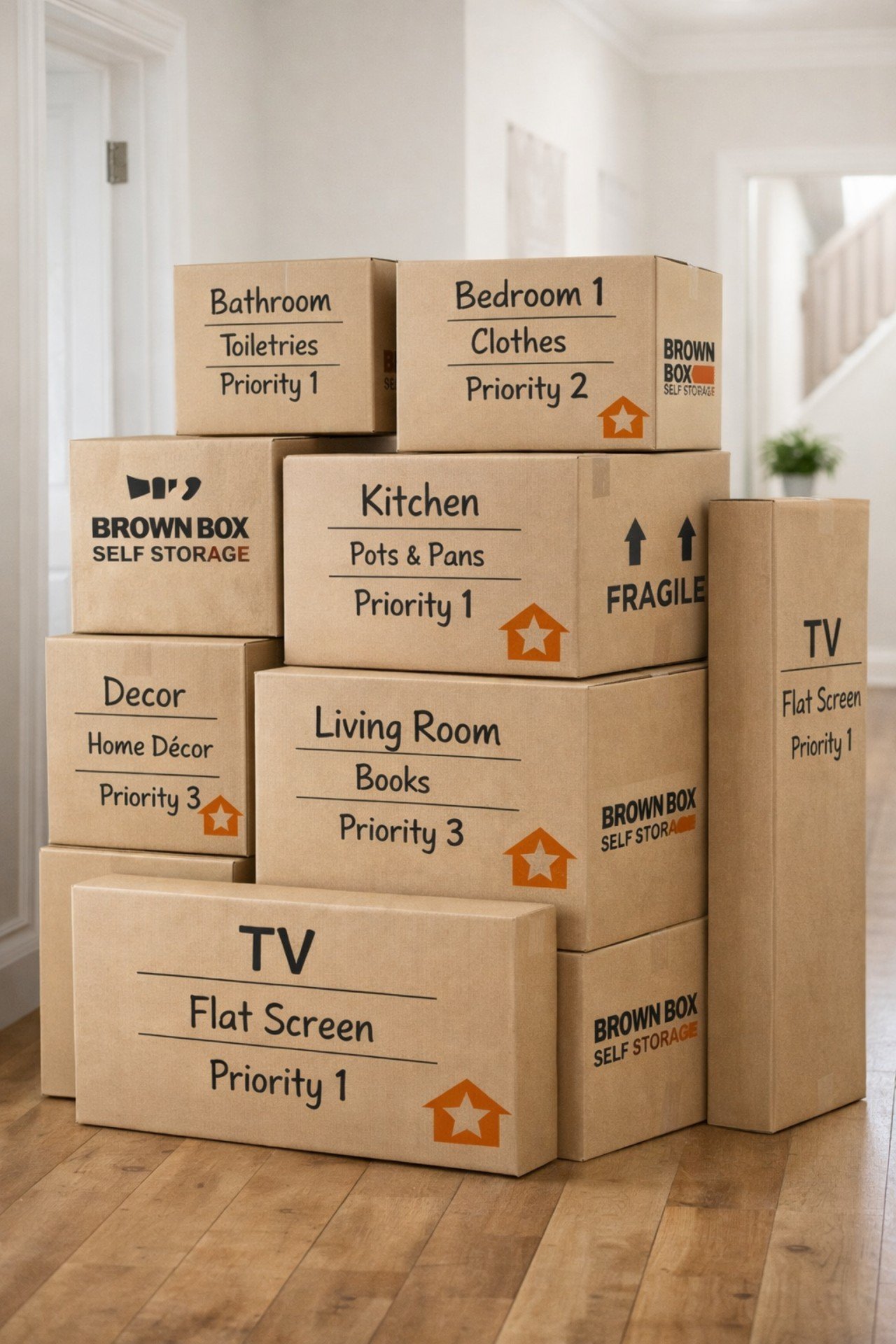
3) Label boxes like you mean it (3 things on every box)
Write this on two sides of every box (not just the top, tops disappear when stacked):
- Room (Kitchen / Bedroom 2 / Loft)
- Category (Plates / Cables / Pantry)
- Priority: 1 = open first, 2 = soon, 3 = later
Example:
Kitchen | Plates & Glass | Priority 1
Pro tip: label with a proper thick marker. If you can’t read it from two metres away, it’s not a label, it’s a wish.
This turns unloading from chaos into a system.
4) Pack a “First Night” box and keep it with you
This is the difference between “we’ve moved!” and “why are we eating crisps with a screwdriver”.
- Kettle + tea/coffee + mugs
- Toilet roll (plural)
- Phone chargers + extension lead
- Basic cutlery + plates + bin bags
- Snacks + water
- Cleaning wipes + hand soap
- Bedding for the first night
- Basic tools (screwdriver, tape, scissors)
- Any meds you actually need
- Kids/pet essentials if relevant
Keep it in your car, not buried in the van like buried treasure.
5) Fragile packing that actually works (not “wrap it in hope”)
The goal is simple: no movement inside the box.
- Line the bottom with scrunched paper/soft padding
- Wrap items individually
- Fill empty space so nothing rattles
- Mark FRAGILE and arrow-up on two sides
- Don’t overpack: crushed boxes = broken items
Extra tip: plates are stronger packed on edge like records than stacked flat.
Don’t rely on newspaper and prayers. Bubble wrap and decent tape cost less than replacing smashed glass.
6) The packing kit you actually need (and where to get it)
You don’t need a trolley full of random gadgets. You need the basics, in decent quality, so boxes don’t split and fragile stuff doesn’t die.
Your minimum kit:
- Strong cardboard moving boxes (small + medium are the workhorses)
- Proper packing tape (not the bargain stuff that peels off mid-lift)
- A thick marker for labelling
- Bubble wrap / packing paper for breakables
- Bin liners for soft bits and last-minute chaos
- Optional but life-saving: wardrobe boxes for hanging clothes and TV boxes for screens
If you’re moving locally around Tamworth, you can pick these up from Brown Box Storage as well, so you’re not doing the “panic shop” the night before completion.
7) Wardrobes and drawers: don’t empty what you don’t need to
Moving day is not the time to “Marie Kondo” your life. You’re relocating, not reinventing yourself.
- Clothes on hangers: use wardrobe boxes, or the cheap hack below
- Drawers: you can often leave light clothes inside, but remove anything heavy
- Tape drawers shut or wrap the whole unit so it doesn’t explode in transit
8) The latest moving & packing hacks (worth it vs nonsense)
The internet is full of “moving hacks”. Some are genuinely brilliant. Some are just… content.
GREEN: actually worth doing
1) Door signs in the new house
Put a big sign on each door: “Kitchen”, “Main bedroom”, “Bathroom”.
Every box goes straight where it belongs. No hallway pile of doom.
2) QR code labels (scan to see what’s inside)
If you can handle a tiny bit of organisation, this is magic.
Make a simple inventory list, stick a QR code on the box, scan it later.
3) Pack drawer-by-drawer
One drawer = one box. Label it. Move on.
It keeps momentum when you’re tired and tempted to quit.
4) Keep clothes on hangers, slide into bin liners/garment bags
Fastest wardrobe move. Hook ends stick out the top, tie around them. Done.
5) Suitcases for heavy stuff
Books, tools, kitchen appliances: suitcases have wheels for a reason.
6) Space bags for duvets and bulky soft stuff
Great for move week. Makes loading easier and saves space.
YELLOW: works, but don’t be daft
1) Use towels/linens instead of bubble wrap
Fine for padding, but it doesn’t replace the “no movement in the box” rule.
2) Clear plastic tubs instead of cardboard
Strong and stackable, but they’re pricier and can tempt you to overpack.
RED: leave it to the influencers
Styrofoam plates between dishes
Wasteful, fiddly, and still doesn’t fix movement inside the box. Pack properly instead.
9) Load the van in the right order (so stuff doesn’t get smashed)
Load like you’re building a stable wall, not chucking things into a skip:
- Big heavy items first (sofas, appliances, wardrobes)
- Mattresses/flat items along the sides (protective “walls”)
- Medium boxes stacked (heavy bottom, light top)
- Fragile boxes last, wedged so they can’t slide
- Fill gaps with soft bags/duvets to stop shifting
If you’re doing multiple trips: Trip 1 should include First Night + essential furniture.
10) The Tamworth move cheat code: create breathing space with storage
Here’s what nobody tells you until you’ve lived through it:
If your move has overlap, delays, decorating, cleaning, or downsizing decisions, don’t drag every single item into the new house immediately.
Better plan:
- Move in the essentials
- Put “non-urgent” stuff into secure indoor storage
- Unpack and set the house up properly
- Bring things out gradually, when you know where they actually belong
This is especially useful if you’re:
- Waiting on keys or completion dates
- Renovating (dust + chaos)
- Downsizing and need time to decide
- Between houses or living temporarily
If you’re moving in or around Tamworth, Brown Box Storage gives you that buffer so the move feels controlled, not like a panic sprint.
11) Quick packing timeline (so you don’t leave it all to the last weekend)
2–3 weeks out
- Order boxes/tape/marker
- Start with loft/garage (high effort, big win)
- Pack “later” items: books, decor, spare bedding
1 week out
- Pack most rooms except daily essentials
- Confirm moving plan and key collection
- Create your First Night box
Last 48 hours
- Strip beds last
- Fridge/freezer plan (cool bag, defrost if needed)
- Keep important documents/keys with you
Final word (and the bit where we help)
Pack smart, label properly, keep heavy items in small boxes, and don’t gamble with “Misc”.
If you’re moving house in Tamworth and want it to feel less chaotic, we can help with the lot: indoor self storage for breathing space, Man & Van help if you need muscle, and packaging materials (boxes, tape, bubble wrap, wardrobe/TV boxes) so you’re not scrambling last minute.
Get in touch with Brown Box Storage and we’ll point you at the right unit size and the right kit for your move.